

Carbon dioxide (CO₂) monitoring has become a critical component of modern air quality management systems across commercial buildings, industrial environments, agriculture, transportation, and residential spaces. As concerns over indoor air quality (IAQ), energy efficiency, and occupant health continue to grow, the demand for accurate and reliable CO₂ sensing technologies is accelerating rapidly.
Among the various sensing methods available today, Non-Dispersive Infrared (NDIR) technology remains the industry benchmark for CO₂ measurement. NDIR sensors are widely adopted due to their precision, stability, and long operational life. They operate by analyzing how CO₂ molecules absorb specific wavelengths of infrared light, enabling accurate gas concentration measurement without direct chemical interaction.
This article explores the core technologies behind CO₂ sensing, compares leading sensor types, examines real-world applications, and highlights emerging innovations shaping the future of air quality monitoring.
Non-Dispersive Infrared (NDIR) sensors are based on a simple but highly effective physical principle: gas molecules absorb infrared (IR) radiation at specific wavelengths. In the case of CO₂, the gas strongly absorbs IR light around the 4.26 μm wavelength.
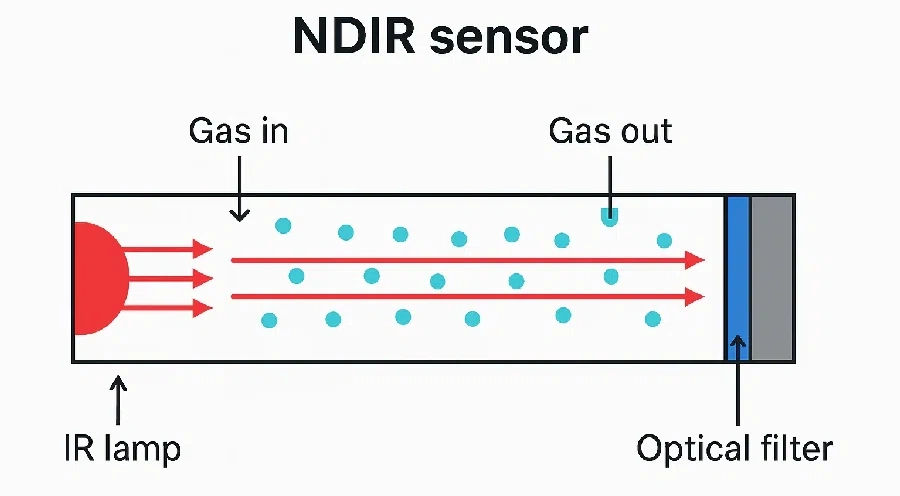
An NDIR CO₂ sensor typically consists of an infrared light source, a sample chamber, an optical filter, and an IR detector. The process works as follows:
- The IR source emits a beam through the gas sample chamber.
- CO₂ molecules within the chamber absorb part of the IR light.
- The detector measures the remaining light intensity after absorption.
- The sensor calculates CO₂ concentration based on the reduction in signal strength.
Because this method relies on physical absorption rather than chemical reactions, NDIR sensors offer several key advantages:
- High measurement accuracy
- Long-term stability
- Minimal cross-sensitivity to other gases
- Low maintenance requirements
- Extended operational lifespan
These benefits have made NDIR technology the dominant choice for professional-grade CO₂ monitoring systems, especially in HVAC systems, building automation, and environmental monitoring equipment.
While NDIR remains the leading technology, several alternative CO₂ sensing methods are also used depending on cost, application, and performance requirements.
NDIR sensors are widely regarded as the most reliable and accurate CO₂ measurement solution. They are used in commercial buildings, industrial safety systems, and environmental monitoring platforms.
Key advantages include:
- High precision across a wide measurement range
- Strong resistance to environmental interference
- Long calibration intervals
- Stable performance over time
These sensors are especially suited for applications where long-term accuracy and reliability are essential.
Electrochemical sensors operate through a chemical reaction between CO₂ (or other gases) and an electrolyte solution, generating an electrical signal proportional to gas concentration.
Although commonly used for gases such as carbon monoxide (CO), ozone (O₃), and nitrogen oxides (NOx), their use in CO₂ detection is more limited.
Limitations include:
- Shorter operational lifespan
- Higher drift over time
- Frequent calibration requirements
- Sensitivity to environmental changes such as humidity and temperature
Due to these constraints, electrochemical sensors are less commonly used for long-term CO₂ monitoring applications.
Solid-state sensors, often based on metal oxide semiconductor (MOS) technology, detect gas concentration through changes in electrical resistance when exposed to CO₂.
These sensors are typically:
- Low-cost
- Compact in size
- Suitable for consumer-grade devices
- However, they have several drawbacks:
- Lower accuracy compared to NDIR
- High cross-sensitivity to other gases
- Frequent calibration needs
- Reduced stability over long periods
As a result, solid-state sensors are generally used in low-cost air quality monitors rather than industrial-grade systems.
CO₂ is not typically harmful at normal indoor concentrations, but it is widely used as a key indicator of indoor air quality. Elevated CO₂ levels often signal poor ventilation, which can lead to:
- Reduced cognitive performance
- Fatigue and drowsiness
- Increased transmission risk of airborne contaminants
- Lower productivity in workplaces and schools
Maintaining optimal CO₂ levels is essential in environments such as:
- Office buildings
- Schools and universities
- Hospitals and healthcare facilities
- Public transportation systems
- Smart homes and residential buildings
Typical recommended indoor CO₂ concentration ranges are:
- 400–800 ppm: Good air quality
- 800–1000 ppm: Acceptable but ventilation recommended
- 1000–2000 ppm: Poor air quality, discomfort likely
- Above 2000 ppm: Unhealthy indoor conditions
This makes CO₂ sensors a cornerstone of modern HVAC and building automation systems.
One of the largest application areas for CO₂ sensors is HVAC control in smart buildings. By integrating NDIR sensors into ventilation systems, building operators can dynamically adjust airflow based on real-time occupancy levels.
This leads to:
- Improved indoor comfort
- Reduced energy consumption
- Lower operational costs
- Enhanced environmental sustainability
Demand-controlled ventilation (DCV) systems rely heavily on CO₂ data to optimize fresh air intake while avoiding unnecessary energy waste.
In industrial environments, CO₂ sensors are used for safety monitoring and process control. High CO₂ concentrations may indicate equipment malfunction, combustion processes, or gas leaks in confined spaces.
Industries using CO₂ monitoring include:
- Chemical processing
- Food and beverage production
- Oil and gas facilities
- Power plants
Accurate CO₂ measurement ensures worker safety and regulatory compliance.
CO₂ plays a vital role in plant photosynthesis, making it an essential parameter in modern agriculture. Controlled CO₂ enrichment in greenhouses can significantly increase crop yield and growth rate.
CO₂ sensors are used to:
- Optimize plant growth conditions
- Control ventilation in greenhouses
- Balance humidity and temperature systems
- Improve agricultural productivity
Precision farming increasingly relies on real-time environmental sensing, including CO₂ monitoring.
Modern vehicles increasingly integrate CO₂ sensors to monitor cabin air quality. High CO₂ levels inside vehicles can lead to driver fatigue and reduced reaction times.
Automotive applications include:
- Cabin air recirculation control
- Driver alertness monitoring systems
- Climate control optimization
This is particularly important in electric vehicles, where energy-efficient HVAC operation is critical.
Consumer-grade air quality monitors often include CO₂ sensors alongside particulate matter (PM2.5), temperature, and humidity sensors.
These devices are widely used in:
- Smart homes
- Offices
- Schools
- Fitness centers
They help users make informed decisions about ventilation and air purification.
The CO₂ sensor industry is undergoing rapid innovation driven by smart building technologies, IoT integration, and environmental regulations.
Manufacturers are developing smaller, more energy-efficient NDIR sensors using micro-electro-mechanical systems (MEMS) technology. These compact sensors are ideal for portable and battery-powered devices.
Benefits include:
- Reduced size and weight
- Lower power consumption
- Faster response times
Modern CO₂ sensors increasingly feature wireless communication capabilities such as:
- Wi-Fi
- Bluetooth Low Energy (BLE)
- Zigbee
- LoRaWAN
This enables real-time data transmission to cloud platforms for remote monitoring and analytics.
Artificial intelligence is being integrated into air quality management systems to analyze CO₂ data alongside other environmental parameters. AI algorithms can predict ventilation needs and optimize energy consumption automatically.
New-generation NDIR sensors are designed with automatic baseline correction and self-calibration features. This reduces maintenance requirements and improves long-term stability.
Instead of measuring only CO₂, modern air quality systems are evolving toward multi-gas sensing platforms that also monitor VOCs, NOx, ozone, and particulate matter. This provides a more comprehensive understanding of air quality conditions.
Despite significant advancements, several challenges remain in the industry:
- Cost vs. performance trade-offs in low-end sensors
- Sensor drift over long-term operation
- Environmental interference (humidity, temperature fluctuations)
- Power consumption in portable applications
- Calibration requirements in large-scale deployments
Manufacturers continue to invest in research and development to overcome these limitations and improve sensor reliability.
The future of CO₂ sensing technology is closely tied to global trends in smart infrastructure, sustainability, and health awareness. As governments introduce stricter building ventilation standards and energy efficiency regulations, demand for high-performance CO₂ sensors is expected to grow significantly.
Key future developments may include:
- Fully self-calibrating NDIR sensors
- Ultra-low-power IoT sensor networks
- Integration with smart city infrastructure
- AI-based predictive ventilation systems
- Advanced materials for improved optical stability
CO₂ sensors will continue to play a central role in shaping healthier, more energy-efficient environments worldwide.
Air quality carbon dioxide sensors have evolved into essential tools for modern environmental monitoring and building management systems. Among available technologies, NDIR sensors remain the industry standard due to their accuracy, stability, and long operational life.
While alternative technologies such as electrochemical and solid-state sensors offer cost advantages in certain applications, they generally cannot match the performance and reliability of NDIR-based systems.
With ongoing advancements in IoT integration, miniaturization, and AI-driven analytics, CO₂ sensing technology is entering a new era of intelligence and efficiency. As awareness of indoor air quality continues to rise globally, CO₂ sensors will remain a foundational component of smart, healthy, and sustainable environments.
Previous: How Air Quality Monitoring Sensors Improve Indoor Air Quality and Safety
Next: How Optical Dust Sensors Improve Environmental Monitoring and Public Health



