

Indoor air quality has become an increasingly important concern in modern society. As urbanization, industrialization, and environmental pollution continue to rise, people are spending more time indoors where air contaminants may accumulate without proper ventilation. Among the various pollutants affecting indoor environments, PM2.5 particulate matter is considered one of the most harmful due to its extremely small particle size and ability to penetrate deep into the human respiratory system.
To address these concerns, indoor PM2.5 dust sensors have become essential components in modern air quality monitoring systems. These sensors provide real-time measurement of airborne particulate matter, helping users understand indoor pollution levels and improve living and working environments.
Indoor PM2.5 dust sensors are now widely used in homes, offices, hospitals, schools, factories, air purifiers, HVAC systems, smart buildings, and environmental monitoring equipment. With rapid advancements in sensing technology, modern PM2.5 sensors offer high accuracy, compact size, low power consumption, and intelligent connectivity features.
This article explores the working principles, types, technologies, applications, advantages, challenges, and future development trends of indoor PM2.5 dust sensors.
PM2.5 refers to particulate matter with a diameter of 2.5 micrometers or smaller. These particles are extremely tiny and can remain suspended in the air for long periods.
Because of their small size, PM2.5 particles can easily bypass the body's natural filtration systems and enter deep into the lungs and bloodstream, potentially causing serious health problems.
PM2.5 particles originate from many different sources, including:
- Vehicle exhaust emissions
- Industrial smoke and combustion
- Cooking fumes
- Cigarette smoke
- Construction dust
- Wildfires
- Household chemicals
- Pollen and biological particles
Indoor environments may contain high PM2.5 concentrations even when outdoor pollution levels appear moderate.
PM2.5 pollution poses significant health risks, especially during long-term exposure.
Respiratory Problems
Fine particles can irritate the respiratory system and contribute to:
- Asthma
- Bronchitis
- Chronic coughing
- Lung inflammation
- Reduced lung function
Cardiovascular Diseases
Studies have shown that PM2.5 exposure may increase the risk of:
- Heart disease
- Stroke
- High blood pressure
- Irregular heartbeat
Vulnerable Groups
Certain populations are more sensitive to PM2.5 pollution:
- Children
- Elderly individuals
- Pregnant women
- People with respiratory conditions
- Individuals with weakened immune systems
Maintaining good indoor air quality is therefore essential for public health and safety.
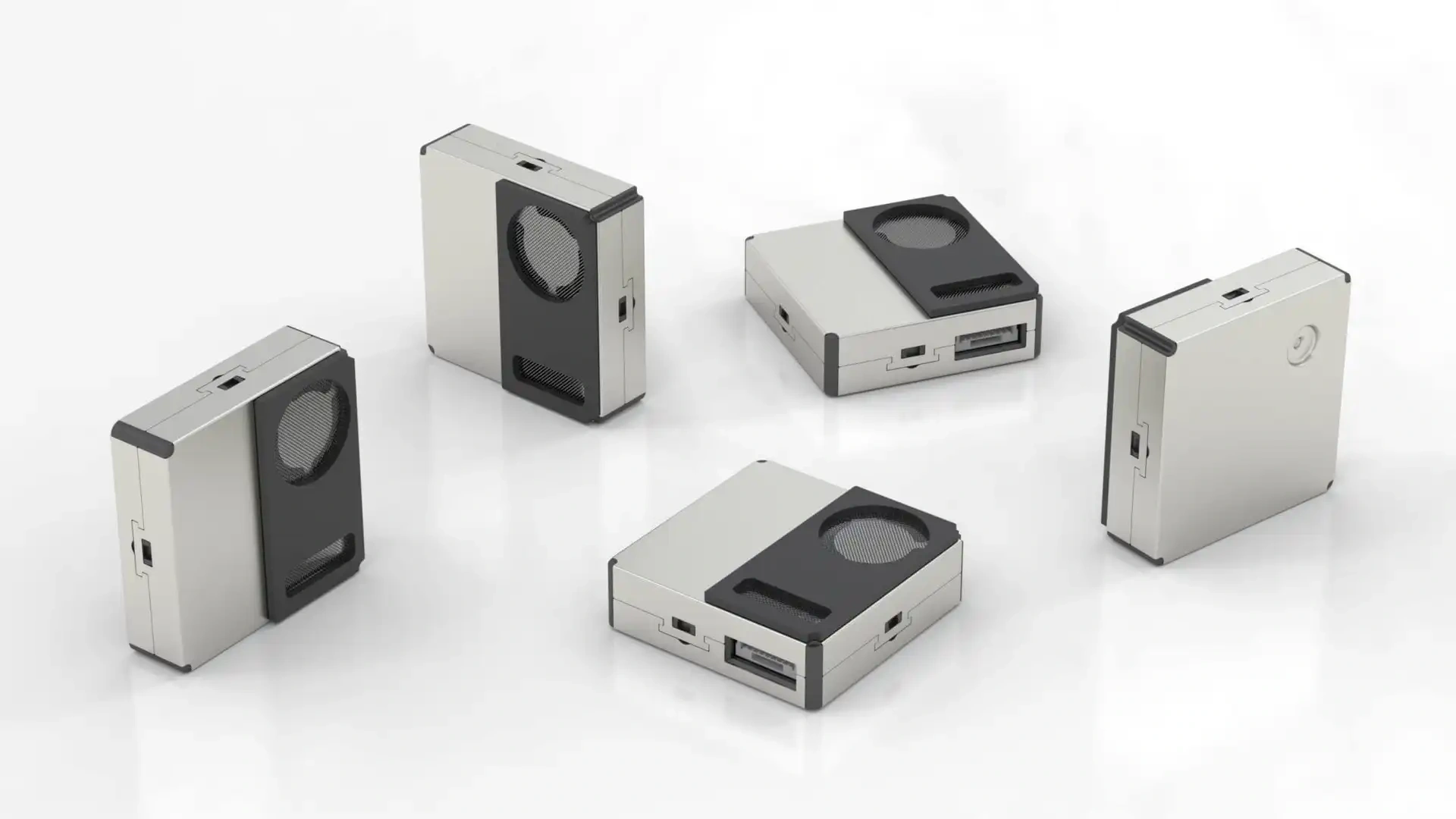
An indoor PM2.5 dust sensor is a device designed to detect and measure the concentration of fine particulate matter suspended in indoor air.
These sensors continuously monitor air quality and provide real-time data, typically measured in micrograms per cubic meter (μg/m³).
The sensor draws air into a detection chamber and uses advanced optical or laser-based technologies to identify airborne particles.
Indoor PM2.5 sensors are commonly integrated into:
- Air purifiers
- Smart thermostats
- HVAC systems
- Environmental monitoring stations
- Smart home systems
- Air quality monitors
- Building automation systems
Modern PM2.5 sensors generally operate using optical detection principles.
Air Sampling
An internal fan or airflow system pulls ambient air into the sensor chamber.
Light Source Emission
The sensor uses a laser diode or infrared light source to illuminate particles inside the chamber.
Light Scattering Detection
As airborne particles pass through the light beam, they scatter light in different directions.
A photodetector measures the scattered light intensity.
Particle Analysis
The sensor's internal processor analyzes the scattering data to estimate:
- Particle size
- Particle concentration
- PM1.0 levels
- PM2.5 levels
- PM10 levels
The results are then displayed digitally or transmitted to connected devices.
Different sensor technologies are available depending on accuracy requirements, cost, and application.
Laser sensors are among the most widely used and accurate PM2.5 detection technologies.
Features
- High precision
- Fast response time
- Real-time monitoring
- Detection of extremely small particles
- Stable performance
Applications
Air purifiers
- Smart home systems
- Industrial monitoring
- Medical environments
Laser PM2.5 sensors have become the industry standard for high-performance air quality monitoring.
Infrared sensors use infrared light to detect particles.
Advantages
- Lower cost
- Simple structure
- Compact size
- Limitations
- Lower precision
- Reduced sensitivity to smaller particles
- Less accurate in varying humidity conditions
These sensors are commonly used in budget air quality devices.
Industrial-grade sensors are designed for demanding environments.
Features
- High durability
- Long operational lifespan
- Wide measurement range
- Enhanced environmental resistance
Applications
Factories
- Manufacturing plants
- Warehouses
- Industrial automation systems
Modern sensors contain several critical components.
Laser or Light Source
Provides illumination for particle detection.
Photodetector
Measures scattered light intensity from airborne particles.
Airflow Fan
Draws ambient air into the sensing chamber.
Signal Processing Circuit
Converts optical signals into measurable particle concentration data.
Microcontroller Unit
Processes data, controls operation, and communicates with external systems.
Indoor PM2.5 sensors provide many important benefits.
Users receive instant information about indoor pollution levels.
This allows rapid response when pollution rises.
By identifying harmful particulate concentrations, sensors help users take corrective actions such as:
- Improving ventilation
- Activating air purifiers
- Reducing pollutant sources
Modern sensors support integration with smart systems.
They can automatically control:
- Air purifiers
- Ventilation systems
- HVAC equipment
- Smart windows
Smart air quality monitoring enables optimized operation of ventilation and purification systems, reducing energy consumption.
Modern PM2.5 sensors are lightweight and compact, allowing easy installation in various indoor environments.
PM2.5 monitoring technology is widely used across many industries.
Homeowners use PM2.5 sensors to improve indoor living conditions.
Common sources of indoor pollution include:
- Cooking smoke
- Pet dander
- Cleaning chemicals
- Tobacco smoke
Sensors help maintain healthier indoor environments.
Many air purifiers use integrated PM2.5 sensors to automatically adjust purification speed based on detected pollution levels.
Heating, ventilation, and air conditioning systems increasingly incorporate air quality monitoring sensors.
Benefits include:
- Intelligent ventilation control
- Improved filtration management
- Enhanced indoor comfort
Medical environments require strict air quality standards.
PM2.5 sensors help monitor airborne contaminants and reduce infection risks.
Schools use air quality monitoring systems to maintain healthy learning environments for students and teachers.
Smart office buildings use PM2.5 monitoring to optimize employee comfort and workplace health.
Factories and industrial sites use PM2.5 sensors to:
- Monitor dust emissions
- Improve worker safety
- Comply with environmental regulations
PM2.5 sensors are important components of smart city environmental monitoring networks.
They provide real-time pollution data for urban management systems.
Indoor air quality directly impacts health, productivity, and comfort.
People now spend most of their time indoors, increasing the importance of monitoring invisible pollutants such as PM2.5.
Poor indoor air quality may lead to:
- Reduced productivity
- Fatigue
- Allergic reactions
- Respiratory illnesses
- Long-term health complications
PM2.5 sensors help users identify pollution sources and maintain safer environments.
Several factors determine sensor performance.
Detection Range
Defines the concentration range measurable by the sensor.
Sensitivity
Indicates the sensor's ability to detect very small particles.
Accuracy
Measures how closely sensor readings match actual particle concentrations.
Response Time
Determines how quickly the sensor updates air quality data.
Lifespan
High-quality sensors are designed for long-term continuous operation.
Environmental Adaptability
Good sensors maintain stable performance under varying:
- Temperature
- Humidity
- Airflow conditions
Despite technological advancements, several challenges remain.
Calibration Stability
Sensors may drift over time and require recalibration.
Humidity Interference
High humidity can affect optical measurements and reduce accuracy.
Dust Accumulation
Long-term exposure to particles may contaminate sensor components.
Cost of High-Precision Sensors
Advanced laser-based sensors can be relatively expensive.
Measurement Consistency
Different sensor models may produce varying readings under identical conditions.
The PM2.5 sensor industry continues to evolve rapidly.
AI-Based Air Quality Analysis
Artificial intelligence improves sensor performance through:
- Data correction
- Predictive pollution analysis
- Intelligent ventilation control
IoT Connectivity
Modern sensors support:
- Wi-Fi
- Bluetooth
- Cloud platforms
- Mobile applications
This allows remote monitoring and smart automation.
Miniaturization
Advances in semiconductor technology are enabling smaller and more portable sensors.
Many modern devices combine PM2.5 monitoring with:
- Temperature sensing
- Humidity sensing
- VOC detection
- CO2 monitoring
Low-Power Sensor Technology
Energy-efficient designs extend battery life in portable monitoring devices.
The future of air quality monitoring will focus on intelligence, automation, and environmental sustainability.
Smart Building Integration
Future buildings will use integrated sensor networks to optimize indoor environments automatically.
Personalized Air Quality Monitoring
Wearable and portable sensors may provide individual exposure tracking.
Enhanced Sensor Accuracy
New optical and AI technologies will further improve detection precision.
Wider Adoption in Consumer Electronics
PM2.5 sensors are increasingly integrated into:
- Smartphones
- Smart appliances
- Vehicles
- Wearable devices
Global Demand Growth
Increasing awareness of air pollution and health risks continues to drive strong market demand for indoor air quality monitoring solutions.
Indoor PM2.5 dust sensors have become essential tools for monitoring and improving indoor air quality. By detecting fine particulate matter in real time, these sensors help protect human health, improve living conditions, and support smarter environmental management.
With applications across residential, commercial, industrial, and healthcare sectors, PM2.5 sensors are playing a growing role in modern smart buildings and air purification systems. Their ability to provide accurate, real-time pollution monitoring allows users to respond quickly to changing air conditions and maintain safer indoor environments.
As technology advances, future PM2.5 sensors will become more accurate, intelligent, compact, and connected. Innovations in artificial intelligence, IoT integration, and smart automation will continue to expand the capabilities and applications of indoor air quality monitoring systems worldwide.
Previous: Air Quality Monitor for Indoor Air Quality and Smart Living
Next: Wall Humidity Sensor Solutions for Mold Prevention and Climate Control