

Carbon dioxide (CO2) is a naturally occurring gas that plays a critical role in life on Earth, but excessive concentrations indoors or in industrial environments can pose serious health risks. As awareness of indoor air quality and environmental monitoring grows, accurate CO2 detection has become more important than ever. Among the many sensing technologies available, Non-Dispersive Infrared (NDIR) sensors stand out as one of the most reliable and widely used methods for detecting CO2.
Commonly referred to as CO2 sensors or CO2 NDIR sensors, these devices are extensively applied in air quality monitoring systems, industrial safety equipment, HVAC controls, greenhouses, automotive cabins, and environmental monitoring stations. NDIR sensors operate on the principle of infrared (IR) absorption. They use an infrared light source and a photodetector to measure the amount of IR radiation absorbed by CO2 molecules in a sample, correlating this absorption to the gas concentration. This makes them highly precise, durable, and suitable for long-term monitoring applications.
In this article, we will explore the underlying principles, components, operation, and practical applications of NDIR CO2 sensors, helping readers understand why this technology is so essential in both everyday life and industrial applications.
NDIR, short for Non-Dispersive Infrared, is a term widely used in the gas sensing industry. It refers to a detection method in which a specific wavelength of infrared light is absorbed by gas molecules without requiring a dispersive element, such as a prism or diffraction grating, to separate the wavelengths. This makes NDIR sensors particularly efficient for detecting gases like CO2 with high selectivity and minimal interference.
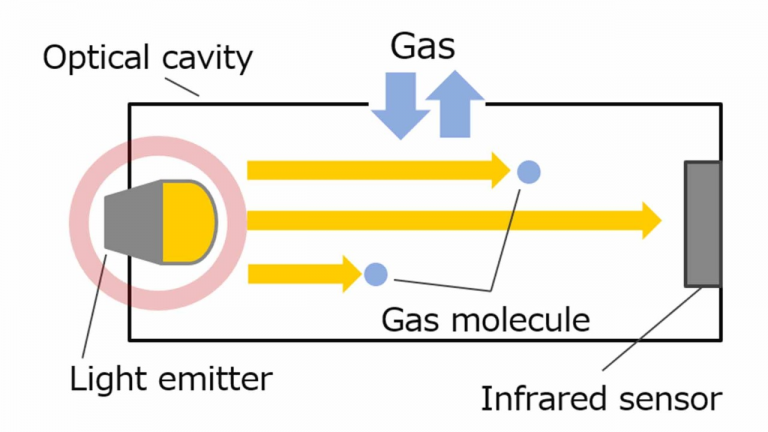
NDIR sensors operate by emitting infrared light from a source, such as an IR lamp or LED, through a gas sample chamber. As the light passes through the air containing CO2 molecules, a specific portion of the IR spectrum is absorbed. The remaining light reaches an optical filter in front of a photodetector, which measures the intensity of the transmitted light.
The key to NDIR’s accuracy is selecting the correct absorption wavelength. For CO2, the absorption peak occurs around 4.26 microns. This wavelength is unique to CO2, meaning other gases or water vapor do not significantly interfere with the measurement. By detecting how much of this specific wavelength is absorbed, the sensor can determine the CO2 concentration in the air.
Think of it as a molecular fingerprint: just as each person has a unique fingerprint, each gas molecule absorbs light at a distinct wavelength. NDIR sensors exploit this property to measure CO2 with remarkable specificity.
At its core, an NDIR CO2 sensor is a sophisticated optical instrument designed to detect infrared absorption. The operation involves four main elements: an infrared light source, a gas sample chamber, an optical filter, and an IR detector.
Infrared Source: The sensor begins with an IR lamp or LED that emits a broad spectrum of infrared light. The light is directed into a gas chamber or tube, which is either filled with ambient air or a pumped gas sample.
Gas Sample Interaction: As the infrared light passes through the gas chamber, CO2 molecules absorb a portion of the light at the characteristic 4.26-micron wavelength. Other wavelengths pass through largely unaffected.
Optical Filtering: Before reaching the detector, the light passes through an optical filter designed to allow only the specific wavelength absorbed by CO2. This ensures that the detector measures only the light relevant to CO2, minimizing interference from other gases or humidity.
Detection and Measurement: The remaining light reaches a photodetector, often a pyroelectric sensor, which converts the infrared radiation into an electrical signal. The sensor then calculates the difference between the emitted and detected light. This decrease in transmitted IR light is directly proportional to the CO2 concentration in the sample.
The result is a precise measurement of CO2 levels in the environment. Notably, NDIR sensors provide real-time readings, high repeatability, and long-term stability, making them ideal for applications where accuracy and reliability are critical.
To better understand how NDIR sensors function, it is essential to examine their primary components in detail:
The infrared light source is usually an LED or miniature lamp that emits radiation at specific wavelengths. The IR source provides the energy required for interactions with CO2 molecules. Its stability and emission profile are critical for accurate sensing, as fluctuations in intensity can affect measurement reliability.
The gas sample cell, often a sealed or flowing chamber, allows the air or gas sample to interact with the infrared light. The length and volume of the chamber are carefully designed to ensure sufficient absorption occurs for measurable results. Some designs use reflective coatings or multiple passes of the light beam to enhance sensitivity.
Optical filters play a crucial role in ensuring accuracy. They selectively allow only the CO2 absorption wavelength (4.26 microns) to reach the detector, blocking other wavelengths that could introduce noise or false readings. This filter ensures high selectivity and reduces interference from other gases or water vapor.
The IR detector converts the filtered infrared light into an electrical signal. Many NDIR sensors use pyroelectric detectors, which exploit the pyroelectric effect—the generation of temporary electrical potential in response to temperature changes caused by IR absorption. The electrical signal from the detector is then processed to determine the CO2 concentration.
By integrating these components, an NDIR CO2 sensor provides precise, reliable, and continuous monitoring of carbon dioxide levels in various environments.
NDIR CO2 sensors offer several key advantages over other sensing technologies, making them widely adopted across multiple industries:
High Selectivity: The ability to target the unique absorption wavelength of CO2 reduces interference from other gases and environmental factors.
Long-Term Stability: NDIR sensors are less prone to drift over time, offering consistent performance without frequent recalibration.
Non-Consumptive Measurement: Unlike chemical sensors, NDIR sensors do not consume the gas during measurement, making them suitable for continuous monitoring.
Wide Measurement Range: These sensors can detect CO2 concentrations from a few parts per million (ppm) to tens of thousands of ppm, suitable for both indoor air quality monitoring and industrial safety applications.
Fast Response Time: Modern NDIR sensors provide near real-time readings, allowing quick response to changing CO2 levels.
NDIR CO2 sensors are incredibly versatile and find use in a wide range of applications, from ensuring indoor comfort to protecting industrial environments.
One of the most common applications is in homes, offices, schools, and public buildings. High CO2 levels can indicate poor ventilation, which may lead to drowsiness, decreased productivity, headaches, and other health issues. By monitoring CO2 levels, NDIR sensors enable building managers and automated systems to maintain healthy indoor air quality.
NDIR CO2 sensors are integrated into Heating, Ventilation, and Air Conditioning systems to optimize airflow. By continuously monitoring CO2, HVAC systems can adjust ventilation rates dynamically, improving energy efficiency while maintaining optimal air quality.
Industries that use or produce CO2, such as breweries, chemical plants, and greenhouses, rely on NDIR sensors for safety monitoring. Sudden increases in CO2 can pose asphyxiation risks, and sensors trigger alarms or safety measures to prevent accidents.
NDIR CO2 sensors are used in environmental research stations to track atmospheric CO2 levels. This data is critical for climate change studies, pollution monitoring, and air quality assessments.
In agriculture, controlled CO2 enrichment can significantly enhance plant growth. NDIR sensors provide precise feedback to automated systems that maintain optimal CO2 concentrations, improving productivity and crop yield.
Automakers integrate NDIR CO2 sensors in vehicle cabins to monitor air quality. The sensors enable ventilation systems to adjust airflow and maintain a comfortable and safe environment for passengers.
As the need for air quality monitoring continues to grow, NDIR technology is evolving to meet higher standards of accuracy, miniaturization, and energy efficiency. Recent innovations include:
Compact Sensors: Smaller NDIR sensors allow integration into portable devices, wearables, and smart home systems.
Low-Power Designs: Optimized power consumption extends the life of battery-operated sensors used in IoT devices.
Multi-Gas Detection: Advanced NDIR sensors can detect multiple gases simultaneously by incorporating additional wavelengths and filters.
Enhanced Signal Processing: Machine learning algorithms are being applied to NDIR outputs for predictive analysis and improved calibration.
These developments ensure that NDIR CO2 sensors remain at the forefront of gas detection technology, contributing to healthier indoor environments, safer industrial operations, and better understanding of environmental changes.
NDIR CO2 sensors represent a cornerstone technology in gas detection and environmental monitoring. By leveraging the unique infrared absorption properties of CO2, these sensors deliver precise, reliable, and real-time measurements across a wide array of applications. From improving indoor air quality to enhancing industrial safety and monitoring greenhouse gas emissions, the versatility and accuracy of NDIR technology make it indispensable in modern life.
Whether for building automation, industrial safety, automotive air quality, or environmental research, NDIR CO2 sensors continue to play a vital role in ensuring safer, healthier, and more sustainable environments.
As technology advances, NDIR sensors will become even more compact, energy-efficient, and intelligent, further solidifying their role as an essential tool for both human well-being and environmental stewardship.
Previous: Air Quality Sensors: Understanding the Application of PM2.5 and PM10 Sensors
Next: Infrared and Laser Dust Sensors: Principles, Applications, and Development Trends