

As global awareness of indoor air quality grows, formaldehyde (chemical formula: CH₂O), a volatile organic compound (VOC), has become a major concern. Present in construction materials, furniture, paint, adhesives, and even cosmetics, formaldehyde is one of the most common pollutants in both residential and industrial settings. Known for its toxicity, formaldehyde can cause a variety of acute and chronic health issues—even at low concentrations.
To combat this invisible threat, formaldehyde detection technologies have become an important line of defense in ensuring healthy indoor environments. Among the different detection methods, electrochemical formaldehyde sensors stand out for their precision, reliability, and affordability. This article explores the scientific principles behind these sensors, their working mechanisms, operating conditions, and real-world applications across various industries.
Formaldehyde is a colorless, flammable gas with a pungent odor, commonly used in industrial and household products. It is also classified as a human carcinogen by the International Agency for Research on Cancer (IARC). The danger lies in its ability to off-gas from common materials over extended periods, leading to prolonged exposure.
When formaldehyde is inhaled in high concentrations, it can irritate the eyes, nose, and throat, trigger asthma attacks, and in severe cases, lead to pulmonary edema or even death. Chronic exposure—even at low levels—has been linked to long-term respiratory disorders, weakened immune responses, and a significantly higher risk of cancers such as nasopharyngeal cancer and leukemia.
Given these health implications, effective monitoring of formaldehyde concentration in the air is crucial for:
Ensuring workplace safety in industrial environments
Assessing indoor air quality in homes, schools, and hospitals
Enhancing product safety in consumer goods manufacturing
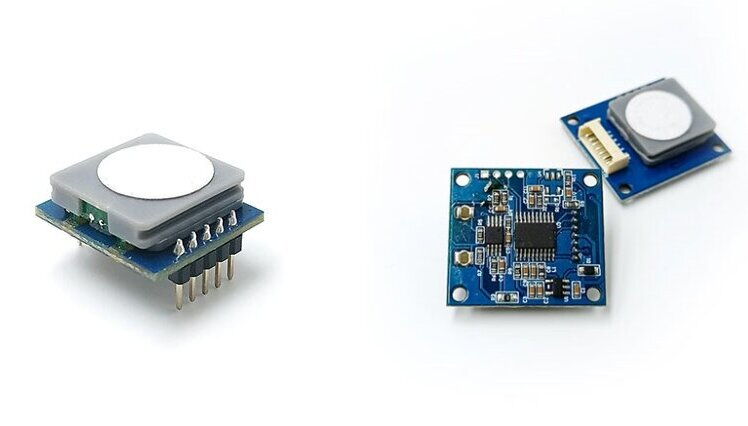
Electrochemical sensors are among the most widely adopted technologies for detecting gases like formaldehyde. Their basic design incorporates electrodes, an electrolyte solution, and a signal-processing circuit. The key working principle revolves around the electrochemical oxidation or reduction of formaldehyde molecules at the electrode surface.
Working Electrode: This is the heart of the sensor where formaldehyde undergoes oxidation.
Counter Electrode: Balances the current generated by the working electrode.
Reference Electrode: Maintains a constant potential for accurate readings.
Electrolyte: Typically a liquid or gel that facilitates ionic movement.
External Circuitry: Converts the electrochemical reaction into a readable output, such as voltage or current.
When the sensor is exposed to air containing formaldehyde, the gas diffuses through a permeable membrane and reaches the working electrode. At a set voltage, the following oxidation reaction typically occurs:
HCHO + H₂O → HCOOH + 2H⁺ + 2e⁻
This reaction releases electrons, which are detected as a current in the external circuit. The strength of this current correlates directly with the concentration of formaldehyde in the air. According to Faraday’s Law of Electrolysis, the generated current (in microamperes) is proportional to the number of molecules undergoing the reaction—thus enabling quantitative analysis.
To improve the performance and responsiveness of the sensor, manufacturers often:
Use catalytic materials such as platinum or gold on the electrode surface to increase reaction rates.
Modify electrode morphology (e.g., using nanostructures) to expand surface area.
Optimize the electrolyte composition to increase ion conductivity and stability.
These measures help reduce response time, increase detection range, and ensure better long-term accuracy.
While electrochemical formaldehyde sensors are highly effective, their performance depends on several external factors:
Most sensors are calibrated to operate within a specific temperature range (e.g., 0°C to 50°C). Extremes in temperature can slow reaction kinetics or affect electrolyte stability, leading to inaccurate readings.
Humidity plays a dual role. Moderate humidity can enhance the sensor's response by facilitating ion movement in the electrolyte. However, excessive moisture may condense on the electrodes, obstructing gas diffusion and diluting the electrolyte.
The sensor requires a stable power source to maintain a constant electrode potential. Fluctuations in voltage or current can skew the electrochemical reaction or disrupt signal output.
Electrochemical sensors may respond to gases other than formaldehyde (e.g., alcohols, CO, NO₂), which can interfere with results. Advanced models incorporate filters or algorithm-based compensation to mitigate this issue.
Due to their compact design, real-time response, and ease of integration, electrochemical formaldehyde sensors are used in a wide variety of settings:
Modern air purifiers, smart thermostats, and ventilation systems increasingly include built-in formaldehyde sensors to optimize indoor air quality. These sensors help homeowners:
Receive real-time alerts on VOC levels
Automate ventilation or purification based on pollution levels
Track long-term air quality trends through mobile apps
Integrating sensors into heating, ventilation, and air conditioning systems enables intelligent airflow management. By continuously monitoring formaldehyde, HVAC systems can:
Trigger filtration processes when pollutants spike
Maintain air quality standards in commercial buildings
Reduce energy consumption by optimizing air exchange rates
In sectors like chemical manufacturing, wood processing, textiles, and furniture production, formaldehyde is used extensively. Continuous monitoring is critical to:
Ensure worker safety and comply with OSHA exposure limits
Detect leaks from equipment or storage tanks
Prevent long-term health hazards in enclosed environments
In pathology labs and forensic units, where formaldehyde is used for specimen preservation, sensors are vital for maintaining a safe working environment.
With growing concerns about VOCs in vehicle interiors (from adhesives, seat foams, and plastics), automobile manufacturers are incorporating formaldehyde sensors to:
Monitor cabin air quality
Improve in-car ventilation systems
Enhance passenger health and comfort
Electrochemical sensors are not the only way to measure formaldehyde. Alternative technologies include optical sensors, metal-oxide sensors, and photochemical enzymatic sensors. Each has its strengths and limitations:
Technology | Advantages | Limitations |
Electrochemical | Low cost, compact, high sensitivity, low power consumption | Affected by humidity, shorter lifespan, limited selectivity |
Optical (e.g., NDIR, UV absorption) | High precision, long lifespan, no chemical consumption | Expensive, bulky, requires calibration |
Photochemical (enzyme-based) | High selectivity, real-time monitoring | Sensitive to environmental changes, expensive, poor durability |
Metal-oxide Semiconductor (MOS) | Simple, inexpensive | Less sensitive to formaldehyde specifically, higher power consumption |
Despite some drawbacks, electrochemical sensors remain the preferred choice for many indoor and industrial applications due to their balance between performance and affordability.
Advancements in materials science and microfabrication are driving the next generation of electrochemical formaldehyde sensors. Promising developments include:
Miniaturized MEMS-based sensors for wearable or mobile applications
Nanostructured electrodes for ultra-sensitive detection
AI-powered signal processing for improved selectivity and interference rejection
Self-calibrating systems to extend sensor lifespan and reduce maintenance
As environmental regulations tighten and the demand for real-time indoor air quality monitoring rises, formaldehyde sensors will become increasingly indispensable—particularly in smart cities and sustainable building ecosystems.
Electrochemical formaldehyde sensors offer a scientifically proven, efficient, and accessible solution to detect one of the most pervasive indoor pollutants. By leveraging electrochemical reactions to measure gas concentrations, these sensors empower individuals, businesses, and governments to monitor air quality, enhance public health, and comply with safety regulations.
Whether integrated into consumer products or deployed in industrial settings, formaldehyde sensors are playing a crucial role in building a healthier, cleaner world.
Previous: TVOC Air Quality Detection Module: Understanding, Monitoring, and Ensuring Cleaner Indoor Air
Next: Understanding CO₂ Sensors: How NDIR and Electrochemical Technologies Measure Air Quality