

In recent years, with growing public awareness of environmental health and the surge in smart home technologies, air quality has become an increasingly important topic. People spend nearly 90% of their time indoors—whether at home, in offices, or in vehicles—making indoor air quality a crucial factor affecting overall health and well-being. While pollutants like carbon dioxide (CO₂) and particulate matter (PM2.5) are commonly discussed, one group of invisible contaminants often escapes attention: Total Volatile Organic Compounds, or TVOCs.
TVOCs include a variety of harmful gases such as formaldehyde, benzene, toluene, xylene, ammonia, and other volatile organic compounds commonly released from building materials, paints, cleaning products, furniture, and electronic devices. These gases can accumulate in poorly ventilated spaces, leading to serious indoor air pollution. Long-term exposure can cause headaches, dizziness, fatigue, and respiratory irritation, while chronic exposure may result in liver damage, nervous system disorders, and even cancer.
To detect and control these invisible pollutants, TVOC gas sensors play an essential role. These compact devices monitor VOC concentrations in real-time, helping individuals and organizations assess and improve their air quality for healthier living and working environments.
TVOC is a collective term for Total Volatile Organic Compounds, a group of carbon-based chemicals that easily evaporate at room temperature. VOCs originate from both natural and human-made sources, but indoor concentrations are often much higher due to limited ventilation and continuous emissions from materials and products.
Common indoor sources of VOCs include:
Building materials: paints, varnishes, adhesives, and sealants.
Furniture and flooring: wood preservatives, laminates, and carpeting.
Household products: air fresheners, cleaning agents, and disinfectants.
Office equipment: printers, copiers, and computers emitting solvents and ozone.
Human activities: smoking, cooking, and the use of cosmetics or personal care products.
The World Health Organization (WHO) and U.S. Environmental Protection Agency (EPA) recognize VOCs as major contributors to indoor air pollution, which can affect the immune system, respiratory function, and mental performance. Symptoms such as eye and throat irritation, nausea, loss of appetite, and chronic fatigue have been associated with high TVOC exposure.
Monitoring TVOC levels provides a comprehensive indicator of indoor air pollution, since it is impractical to measure every VOC individually. By evaluating the total VOC concentration, users can quickly assess whether an environment poses health risks and take corrective actions, such as improving ventilation or using air purifiers.
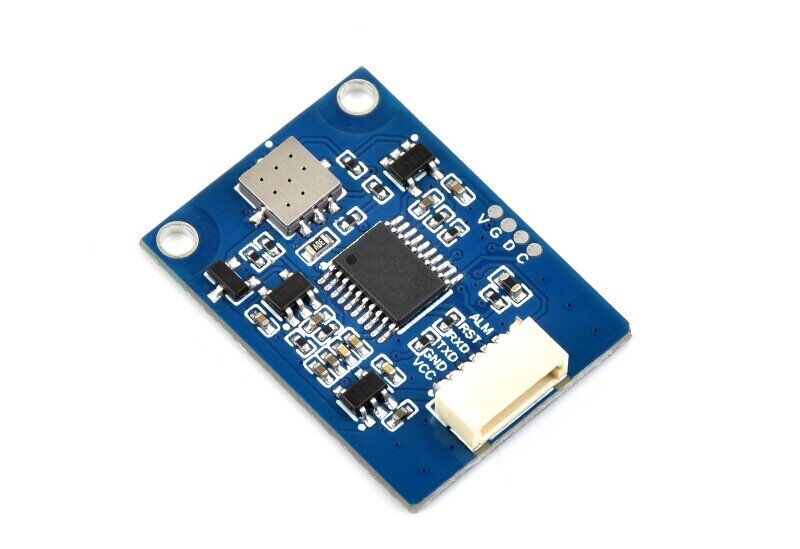
The TVOC gas sensor operates on advanced gas sensing technologies, primarily based on metal oxide semiconductor (MOS) or photoionization detector (PID) principles. The core concept is simple yet highly effective: the sensor detects chemical reactions between VOC molecules and a sensing material, translating those reactions into measurable electrical signals.
Here’s a breakdown of how the typical MOS-based TVOC sensor works:
Inside the sensor, a thin film of metal oxide nanoparticles (often tin dioxide, SnO₂) is heated to around 300°C. When oxygen molecules from the air adsorb onto the surface, they capture free electrons, creating a stable baseline electrical resistance.
When volatile organic compounds come into contact with the heated surface, they react with the adsorbed oxygen. This reaction releases the trapped electrons back into the metal oxide layer, reducing its resistance.
The change in electrical resistance is proportional to the VOC concentration. The sensor’s internal circuit converts this analog resistance change into a digital signal. This data can then be processed, displayed, or transmitted to a microcontroller or monitoring system.
Most modern TVOC sensors provide digital outputs such as I²C or UART, making them easy to integrate with IoT devices, microcontrollers (like Arduino or Raspberry Pi), and smart ventilation systems. Some advanced models also output an equivalent carbon dioxide (eCO₂) reading, offering broader insight into indoor air quality.
Typical TVOC sensors have a detection range of 0–5000 parts per billion (ppb), allowing for precise detection of even minute changes in VOC concentration. High-quality sensors offer excellent sensitivity and repeatability, with response times from a few seconds to minutes, depending on the model and environmental conditions.
For practical applications, TVOC concentration is usually expressed in:
Micrograms per cubic meter (μg/m³)
Milligrams per cubic meter (mg/m³)
Parts per million (ppm)
Parts per billion (ppb)
According to environmental health guidelines:
Below 0.3 mg/m³: Good air quality
0.3–0.5 mg/m³: Acceptable range
Above 0.6 mg/m³: Requires ventilation improvement
Over 1.0 mg/m³: Poor air quality; potential health risk
Experts recommend maintaining indoor TVOC levels below 300 μg/m³ for a safe and comfortable environment.
A common question is whether TVOC sensors respond equally to all types of volatile organic compounds. The answer is no—their response varies depending on each compound’s chemical reactivity, molecular structure, and the sensor’s calibration gas.
For instance, a sensor calibrated using ethanol as the reference gas may produce a stronger response to alcohol-based VOCs compared to less reactive substances like formaldehyde. This variation is inherent to MOS sensor technology, as each VOC interacts differently with the sensing surface.
Despite these differences, the aggregate signal still represents the overall VOC concentration, making TVOC sensors reliable indicators of total air pollution levels rather than precise analyzers for specific compounds.
Working principle: Detect resistance changes in heated metal oxide surfaces upon exposure to VOCs.
Advantages: Cost-effective, compact, long-lasting, and highly sensitive.
Applications: Air purifiers, HVAC systems, smart home devices, and wearable air monitors.
Limitations: Sensitive to temperature and humidity variations; not selective for specific gases.
Working principle: Use ultraviolet (UV) light to ionize VOC molecules and measure the resulting current.
Advantages: Fast response, wide dynamic range, and high accuracy for detecting specific VOCs.
Applications: Industrial safety, environmental monitoring, and laboratory use.
Limitations: More expensive, requires regular calibration and maintenance.
Working principle: Measure infrared light absorption by VOC molecules.
Advantages: Stable and long-lasting; not affected by humidity.
Limitations: Typically used for CO₂ and specific hydrocarbons rather than total VOC detection.
The versatility of TVOC sensors has led to their widespread adoption across multiple industries and environments:
Integrated with air purifiers, smart thermostats, and ventilation systems, TVOC sensors enable real-time air quality adjustments. When pollution levels rise, the system can automatically activate ventilation or filtration to restore healthy conditions.
Continuous TVOC monitoring helps maintain productivity and comfort. Studies show that employees perform better in environments with lower VOC levels, as poor air quality can reduce cognitive function and increase absenteeism.
In manufacturing facilities, printing shops, or chemical plants, TVOC sensors serve as early warning systems for gas leaks or accidental emissions, protecting workers from hazardous exposure.
Hospitals and research facilities rely on precise TVOC detection to maintain sterile and safe environments, particularly in rooms using disinfectants or chemical reagents.
With the rise of smart vehicle cabins, TVOC sensors are integrated into air-conditioning systems to monitor in-cabin air quality, ensuring a healthier and more comfortable driving experience.
Government and environmental agencies use TVOC sensors in air quality monitoring stations to assess pollution levels, contributing to policy decisions and public health data.
Modern TVOC sensors are increasingly connected through the Internet of Things (IoT), enabling data sharing, real-time analysis, and automation. When linked to cloud-based platforms, these sensors can provide:
Continuous remote monitoring via mobile apps or dashboards.
Automatic alerts when pollution levels exceed safe limits.
Data analytics to identify long-term trends in air quality.
Integration with HVAC systems to optimize energy use and ventilation efficiency.
For example, a smart building management system can adjust ventilation rates dynamically based on TVOC readings, ensuring both air quality and energy savings. This kind of AI-driven air management represents the future of sustainable indoor environments.
While TVOC sensors have made significant progress, several challenges remain:
Calibration and Selectivity – Since MOS sensors respond differently to various VOCs, calibration accuracy is critical. Manufacturers are developing advanced algorithms and multi-sensor arrays to improve selectivity.
Environmental Interference – Temperature and humidity fluctuations can affect sensor stability. New materials and compensation techniques are being explored to enhance robustness.
Miniaturization and Power Efficiency – The growing demand for portable and wearable air quality monitors is pushing innovation toward smaller, low-power sensors.
Data Standardization – With different measurement methods and units, establishing standardized metrics for TVOC concentration remains a global priority for consistent air quality evaluation.
Looking forward, emerging technologies such as nanomaterial-based sensors, MEMS fabrication, and AI-enhanced calibration algorithms promise to make TVOC monitoring more accurate, affordable, and widely accessible. As part of integrated smart ecosystems, next-generation TVOC sensors will not only detect air pollutants but also predict and prevent poor air conditions before they occur.
In our modern, enclosed environments, clean air is no longer a guarantee—it’s a necessity that must be actively monitored and maintained. TVOC gas sensors provide a practical, reliable, and cost-effective solution for detecting harmful volatile compounds that compromise indoor air quality.
By continuously measuring total VOC concentrations, these sensors empower homeowners, businesses, and industrial operators to make informed decisions that protect human health and enhance living standards. As technology continues to evolve, the integration of TVOC sensors with smart systems will play a pivotal role in building healthier, safer, and more sustainable indoor environments for the future.
Previous: How Agricultural CO₂ Sensors Boost Crop and Livestock Productivity
Next: Key Factors to Consider When Choosing an Indoor Air Quality Monitoring Device



