

Particulate Matter (PM) has emerged as one of the most critical environmental pollutants impacting public health today. These microscopic particles, especially those with diameters of 10µm or smaller—commonly referred to as PM10 and PM2.5—pose significant health risks because they can penetrate deep into the respiratory system. Exposure to particulate matter has been linked to respiratory diseases, cardiovascular problems, premature death, and even cancer. While most studies and public awareness campaigns have historically focused on outdoor air pollution, indoor air quality is equally significant. People spend approximately 80 to 90% of their time indoors, whether at home, in offices, schools, or public buildings. Indoor air often contains pollutants that remain unnoticed without proper monitoring, making indoor PM exposure a silent yet serious health threat.
Air sampling for particulate matter has been conducted since the 1960s using laboratory-grade equipment. While highly accurate, these instruments are expensive, bulky, and unsuitable for continuous real-world monitoring. Over the past decade, advances in the Internet of Things (IoT) and sensor technology have led to the development of low-cost, real-time PM sensors that are increasingly embedded in Indoor Air Quality (IAQ) monitors. Though these sensors do not yet match the precision of laboratory instruments, they provide real-time feedback on air quality, enabling individuals to take proactive steps to reduce exposure. By giving users actionable data on the air they breathe, these sensors can guide improvements in ventilation, purification, and overall indoor air safety.
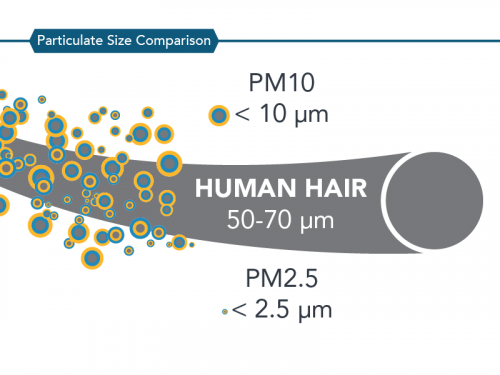
Particulate matter consists of tiny solid particles and liquid droplets suspended in the air. The particles vary in size, composition, and origin. Coarse particles (PM10) are typically between 2.5µm and 10µm in diameter and can irritate the eyes, nose, and throat. Fine particles (PM2.5) are smaller than 2.5µm and can penetrate deep into the lungs and enter the bloodstream, causing more severe health effects. Sources of PM include combustion engines, industrial emissions, construction dust, smoke from fires, and even everyday activities like cooking and cleaning.
Long-term exposure to PM2.5 is linked to chronic respiratory diseases, heart disease, and reduced lung function, while short-term exposure can cause irritation, asthma attacks, and other acute respiratory symptoms. Children, the elderly, and individuals with preexisting health conditions are particularly vulnerable. Monitoring PM levels, especially indoors, is critical to minimizing exposure and protecting vulnerable populations.
Historically, PM monitoring was restricted to laboratories using gravimetric sampling or beta attenuation monitors (BAMs). These methods, while highly precise, are expensive, require specialized personnel, and are unsuitable for continuous monitoring in homes or workplaces.
The emergence of low-cost sensors in the 2010s marked a turning point in accessibility. These sensors leverage light scattering principles to estimate particle concentration in real time, allowing ordinary households and small businesses to monitor air quality continuously. The integration of IoT technology has made it possible to connect PM sensors to apps, cloud platforms, and smart home systems. Users can now receive instant notifications about air quality, track long-term trends, and make informed decisions about ventilation and air purification.
PM sensors can be broadly classified into infrared particle sensors and laser particle sensors, each with unique designs, advantages, and applications.
Infrared PM sensors are among the most common low-cost sensors due to their simplicity and affordability. These sensors use an infrared LED light source to detect particles in the air. The working principle relies on light scattering: as airborne particles pass through the infrared beam, they scatter the light, which is then captured by a photosensitive detector.
The detector converts the scattered light into electrical signals, which are processed to calculate particle concentration. When no particles are present, the sensor outputs a low pulse signal; when particles are detected, the output signal increases proportionally. Infrared sensors are suitable for basic air quality monitoring in homes, classrooms, and offices, providing users with a cost-effective way to detect PM levels in real time.
Laser particle sensors are more advanced and offer higher precision and faster response times than infrared sensors. These sensors use a laser LED light source and often include a fan to maintain a consistent airflow through the sensing chamber. The laser beam passes through the air sample, and particles intersecting the beam scatter light, which is captured by a photodetector at a specific angle.
The photodetector converts the scattered light into an electrical signal, which is amplified and processed to determine the particle concentration accurately. Laser PM sensors are widely used in industrial environments, research facilities, and high-performance indoor air quality monitoring systems. While more expensive than infrared sensors, their reliability and precision make them essential for applications where accurate data is critical.
Despite technological advances, PM sensors are susceptible to failure or inaccurate readings. Understanding these factors helps in maintaining sensor performance:
In automotive and industrial applications, PM sensors often monitor exhaust emissions. Excessive soot accumulation can clog filters and interfere with the sensor’s ability to detect particles, causing failures or error codes. Immediate cleaning or maintenance of the DPF is necessary to restore functionality.
Sensors may produce inaccurate data if they are improperly calibrated or exposed to environmental interference. Regular calibration and maintenance are essential for accurate and reliable results.
Extreme temperatures, humidity, water ingress, or mechanical shocks can damage sensors, leading to malfunctions. Proper placement and environmental protection are crucial for sensor longevity.
Faulty wiring, short circuits, open circuits, or degraded internal components can result in sensor failure. Users should inspect and troubleshoot electrical connections to maintain proper operation.
Over time, sensor components may degrade, leading to reduced sensitivity or slower response times. Regular replacement and preventive maintenance can extend the operational life of PM sensors.
PM sensors are versatile tools used in various sectors to monitor air quality:
Homeowners and facility managers use PM sensors to monitor indoor air pollution. By tracking PM2.5 and PM10 levels, they can identify problem areas, improve ventilation, and reduce exposure to harmful particles.
Factories, construction sites, and manufacturing plants employ PM sensors to protect workers from airborne dust, smoke, and other pollutants. Early detection allows the implementation of safety measures, such as protective equipment or localized ventilation systems.
Municipalities deploy PM sensors to monitor urban air quality. Real-time data supports public health initiatives, traffic management, and environmental policies. Integrated networks of sensors enable authorities to map pollution hotspots and implement targeted interventions.
PM sensors can be integrated into smart home systems, HVAC units, and air purifiers. Users receive real-time alerts, track trends over time, and automate air quality control. This integration enhances convenience and promotes proactive health management.
Researchers use PM sensors to study the effects of air pollution on health and behavior. Schools, universities, and scientific institutions leverage low-cost sensors for educational purposes, raising awareness of indoor air quality among students and communities.
Low-cost PM sensors provide numerous benefits despite being less precise than laboratory instruments:
Affordability: Accessible to households, small businesses, and schools.
Real-Time Monitoring: Continuous feedback helps users respond quickly to changing air quality.
Portability: Compact design allows easy placement in various indoor locations.
Smart Integration: Compatible with IoT systems, apps, and air purifiers for automated air quality management.
Public Awareness: Increases knowledge of particulate matter and encourages healthier living practices.
The real-time, actionable insights offered by these sensors empower individuals to take preventive measures, even if absolute accuracy is slightly lower than laboratory standards.
The field of particulate matter sensing is evolving rapidly, driven by IoT, artificial intelligence, and miniaturization technologies. Future trends include:
Enhanced Accuracy: Improved sensor designs aim to match the precision of laboratory equipment.
AI-Powered Analysis: Machine learning algorithms will predict pollution trends and optimize indoor air management.
Wearable Devices: Personal PM sensors will monitor exposure for individuals in real time, particularly in urban environments with high pollution levels.
Integration with Smart Infrastructure: PM sensors will become standard in smart homes, vehicles, and public transportation to maintain safe air quality automatically.
Sustainable Designs: Low-energy, environmentally friendly sensor designs will reduce power consumption and improve durability.
These trends suggest that PM sensors will not only detect pollutants but also actively help improve air quality through automated systems and predictive insights.
Particulate matter sensors play a pivotal role in safeguarding human health and the environment. From low-cost indoor monitors to high-precision laser sensors, they provide critical data on air quality, enabling proactive measures to reduce exposure. While challenges such as sensor failure and calibration issues persist, advances in IoT, AI, and sensor design are increasing reliability and accessibility.
By empowering individuals, businesses, and municipalities to monitor and act on air quality data, PM sensors contribute to healthier indoor and outdoor environments. They promote informed decision-making, whether through improving home ventilation, enhancing workplace safety, or guiding public health policies.
Ultimately, PM sensors are more than monitoring devices—they are tools for prevention, education, and sustainable living, providing real-time insights to create cleaner, safer spaces for everyone. As air quality concerns grow globally, these sensors will continue to be an essential part of protecting human health and promoting environmental awareness.
Previous: PM2.5 Sensors in Air Conditioning: Revolutionizing Indoor Air Quality
Next: Smart Farming Sensors: Revolutionizing Modern Agriculture