

As urbanization accelerates and industrial activity continues to expand, air pollution has become one of the most pressing environmental and public health challenges of the 21st century. Among various air pollutants, PM2.5 (fine particulate matter with a diameter of 2.5 micrometers or smaller) is widely recognized as one of the most dangerous. These microscopic particles can penetrate deep into the lungs and even enter the bloodstream, leading to serious health issues such as respiratory diseases, cardiovascular problems, and premature death.
In response to growing concerns over air quality, PM2.5 particle sensors have emerged as a vital technology for monitoring, analyzing, and managing air pollution. From smart cities and industrial facilities to homes, offices, and healthcare environments, PM2.5 sensors play an increasingly important role in protecting public health and supporting data-driven environmental policies.
This article explores what PM2.5 is, how PM2.5 particle sensors work, their key technologies, applications, benefits, limitations, and future development trends.
PM2.5 refers to airborne particulate matter with an aerodynamic diameter of 2.5 microns or less—about 1/30th the width of a human hair. These particles originate from a wide range of sources, including:
- Vehicle exhaust emissions
- Industrial combustion processes
- Power generation
- Construction and demolition activities
- Biomass burning and wildfires
- Secondary chemical reactions in the atmosphere
Because of their extremely small size, PM2.5 particles remain suspended in the air for long periods and can travel long distances. More importantly, they can bypass the body’s natural defense mechanisms in the nose and throat, reaching the alveoli in the lungs and entering the bloodstream.
Numerous studies by organizations such as the World Health Organization (WHO) and the U.S. Environmental Protection Agency (EPA) have linked long-term PM2.5 exposure to asthma, lung cancer, heart disease, stroke, and reduced life expectancy. As a result, accurate and real-time monitoring of PM2.5 levels has become essential worldwide.
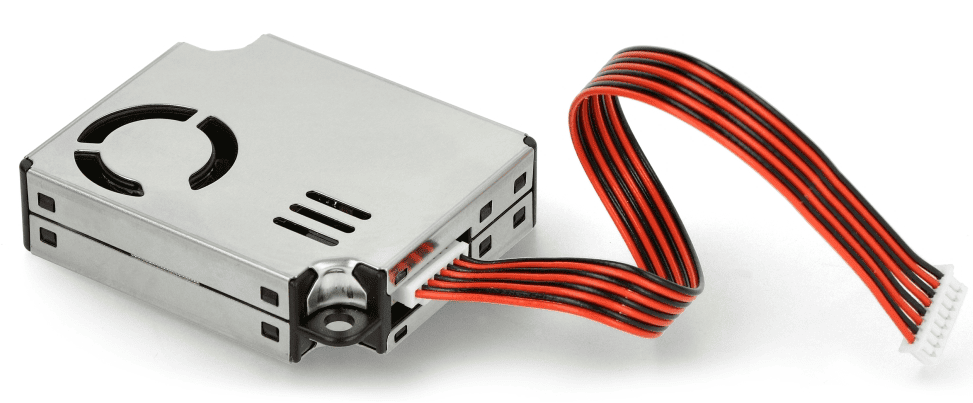
A PM2.5 particle sensor is a device designed to detect and measure the concentration of fine particulate matter suspended in the air. It typically outputs PM2.5 values in micrograms per cubic meter (µg/m³), enabling users to assess air quality levels and take appropriate actions.
Modern PM2.5 sensors are compact, energy-efficient, and capable of providing real-time data. They are widely used in air quality monitoring systems, portable air quality detectors, HVAC systems, air purifiers, smart home devices, and industrial environmental monitoring equipment.
Most PM2.5 particle sensors operate using optical detection technology, although other methods exist. The most common working principles include:
The laser scattering method is the most widely adopted technology in PM2.5 sensors today.
Working principle:
Air is drawn into the sensor chamber by a small fan.
A laser beam illuminates the airborne particles.
When particles pass through the laser, they scatter light.
A photodetector measures the intensity and angle of scattered light.
The sensor’s internal algorithm calculates particle size and concentration based on the scattering data.
Advantages:
High sensitivity
Fast response time
Suitable for continuous monitoring
Compact design
This method enables accurate detection of PM2.5, PM1.0, and PM10 simultaneously in many modern sensors.
In this approach, particles block or obscure a light beam as they pass through the sensing chamber.
Working principle:
A light source emits a beam across the chamber.
Particles passing through reduce the intensity of light reaching the detector.
The reduction is correlated with particle concentration.
Limitations:
Less sensitive to very fine particles
More affected by particle shape and color
As a result, light obscuration is less common for high-precision PM2.5 detection.
Although not typically used in compact sensors, the gravimetric method serves as a reference standard for PM2.5 measurement.
Working principle:
Air is drawn through a filter over a fixed period.
Particles are collected on the filter.
The filter is weighed before and after sampling to determine particle mass.
While highly accurate, this method is labor-intensive and unsuitable for real-time monitoring, making it impractical for consumer or smart monitoring applications.
A typical PM2.5 sensor consists of the following components:
- Laser diode or LED light source
- Photodetector
- Airflow system (fan or pump)
- Signal processing circuit
- Microcontroller and algorithms
- Communication interface (UART, I²C, SPI, or wireless modules)
Advanced sensors may also include temperature and humidity compensation to improve measurement accuracy under varying environmental conditions.
Accuracy is a critical factor in PM2.5 measurement. While professional-grade monitoring stations use reference instruments, modern PM2.5 sensors have made significant progress in closing the gap.
Key factors affecting accuracy include:
Particle composition and density
Humidity levels (high humidity can cause particle growth)
Sensor aging and contamination
Airflow stability
To improve reliability, many manufacturers perform factory calibration using reference-grade instruments. Some advanced systems also support field calibration and cloud-based algorithm updates.
Cities around the world deploy PM2.5 sensors to build dense monitoring networks. These networks provide real-time air quality data at street level, helping authorities:
- Identify pollution hotspots
- Evaluate traffic and industrial emissions
- Issue health advisories
- Develop evidence-based environmental policies
Low-cost PM2.5 sensors have made it feasible to expand monitoring coverage far beyond traditional stations.
In industrial settings, PM2.5 sensors are used to monitor emissions, workplace air quality, and compliance with environmental regulations.
Applications include:
- Manufacturing plants
- Power stations
- Mining operations
- Construction sites
Continuous PM2.5 monitoring helps companies reduce health risks, optimize ventilation systems, and avoid regulatory penalties.
Indoor air pollution is often overlooked, yet people spend up to 90% of their time indoors. PM2.5 sensors are widely integrated into:
- Smart air purifiers
- HVAC systems
- Office building management systems
- Schools and hospitals
By monitoring PM2.5 levels in real time, building operators can adjust ventilation and filtration systems to maintain a healthier indoor environment.
With the rise of smart homes, PM2.5 sensors have become a common feature in consumer air quality monitors and smart devices.
Benefits include:
- Real-time air quality awareness
- Automatic control of air purifiers
- Mobile app notifications
- Health-focused lifestyle management
These devices empower individuals to make informed decisions about ventilation, outdoor activities, and indoor air management.
Hospitals, clinics, and research institutions use PM2.5 sensors to study pollution exposure and its health impacts. In sensitive environments such as neonatal wards and respiratory care units, maintaining low PM2.5 levels is especially critical.
PM2.5 sensors offer numerous advantages:
Real-time monitoring of air quality
Compact and cost-effective designs
Scalable deployment for large networks
Data-driven decision-making
Improved public awareness and health protection
Their accessibility has democratized air quality data, shifting monitoring from centralized systems to distributed, community-level solutions.
Despite their advantages, PM2.5 sensors also face challenges:
Sensitivity to humidity and temperature
Variability in particle composition
Calibration drift over time
Limited accuracy compared to reference instruments
Ongoing research and algorithm optimization continue to address these issues, improving sensor reliability and consistency.
The integration of PM2.5 sensors with IoT platforms has transformed air quality monitoring. Connected sensors can transmit data to cloud servers, enabling:
Real-time dashboards
Historical trend analysis
Predictive pollution modeling
Integration with weather and traffic data
IoT-enabled PM2.5 sensors support smart city initiatives and large-scale environmental intelligence systems.
The PM2.5 sensor market continues to evolve rapidly. Key future trends include:
Higher accuracy through AI-driven algorithms
Multi-parameter sensors combining PM, VOCs, CO₂, and gases
Lower power consumption for battery-powered devices
Miniaturization for wearable applications
Improved humidity compensation
Global standardization of sensor performance
As regulations tighten and public awareness grows, demand for advanced PM2.5 sensing solutions is expected to increase significantly.
PM2.5 particle sensors have become an indispensable tool in the global effort to combat air pollution and protect public health. By providing real-time, actionable data on fine particulate matter, these sensors empower governments, industries, and individuals to better understand and manage air quality.
From smart cities and industrial facilities to homes and healthcare environments, PM2.5 sensors are transforming how we monitor the air we breathe. As technology continues to advance, these sensors will play an even greater role in building cleaner, healthier, and more sustainable living environments for future generations.
In an era where air quality directly impacts quality of life, PM2.5 particle sensors are no longer optional—they are essential.
Previous: Air Quality Detection Sensors: Technology, Applications, and Future Trends
Next: The Growing Role of Infrared Dust Sensors in Environmental Measurement